
What Is Encrypted Email? Everything You Need to Know About Secure Communication
Discover what encrypted email is, how end-to-end encryption (E2EE) protects your digital privacy, and how public and private keys keep your messages safe from cyber threats. Complete with a comprehensive 10-step FAQ guide.
What Is Encrypted Email? Everything You Need to Know About Secure Communication
In an era where data breaches, identity theft, and corporate surveillance are at an all-time high, digital privacy has become a necessity rather than a luxury. Every day, we send sensitive information over the internet—bank statements, passwords, business contracts, and deeply personal messages.
However, many people do not realize that traditional email infrastructure is fundamentally insecure. Sending a standard email is the digital equivalent of "writing a message on the back of a postcard." Anyone handling that postcard along its delivery route can easily read it.
To solve this vulnerability, security experts rely on encrypted email. In this comprehensive guide, we will break down what encrypted email is, how it works, and why switching to a secure email provider is essential for protecting your digital footprint.
What Is Encrypted Email?
Email encryption is a security method that disguises the content of an email message so that it becomes completely unreadable to unauthorized parties. It takes your original, readable message (plaintext) and scrambles it into an undecipherable jumble of characters (ciphertext).
The main goal of email encryption is to protect your data from being intercepted or tampered with as it travels across the internet from your device to the recipient. The message can only be decoded and read by someone who possesses the correct digital "key."
How Does Encrypted Email Work?
The core mechanism behind modern email encryption is cryptography. While there are different types of encryption, the gold standard for ultimate privacy is End-to-End Encryption (E2EE).
In an end-to-end encrypted system, the message is encrypted on the sender's device and remains fully encrypted until it reaches the recipient's device. This means that email service providers, internet service providers (ISPs), and hackers cannot read the content under any circumstances.
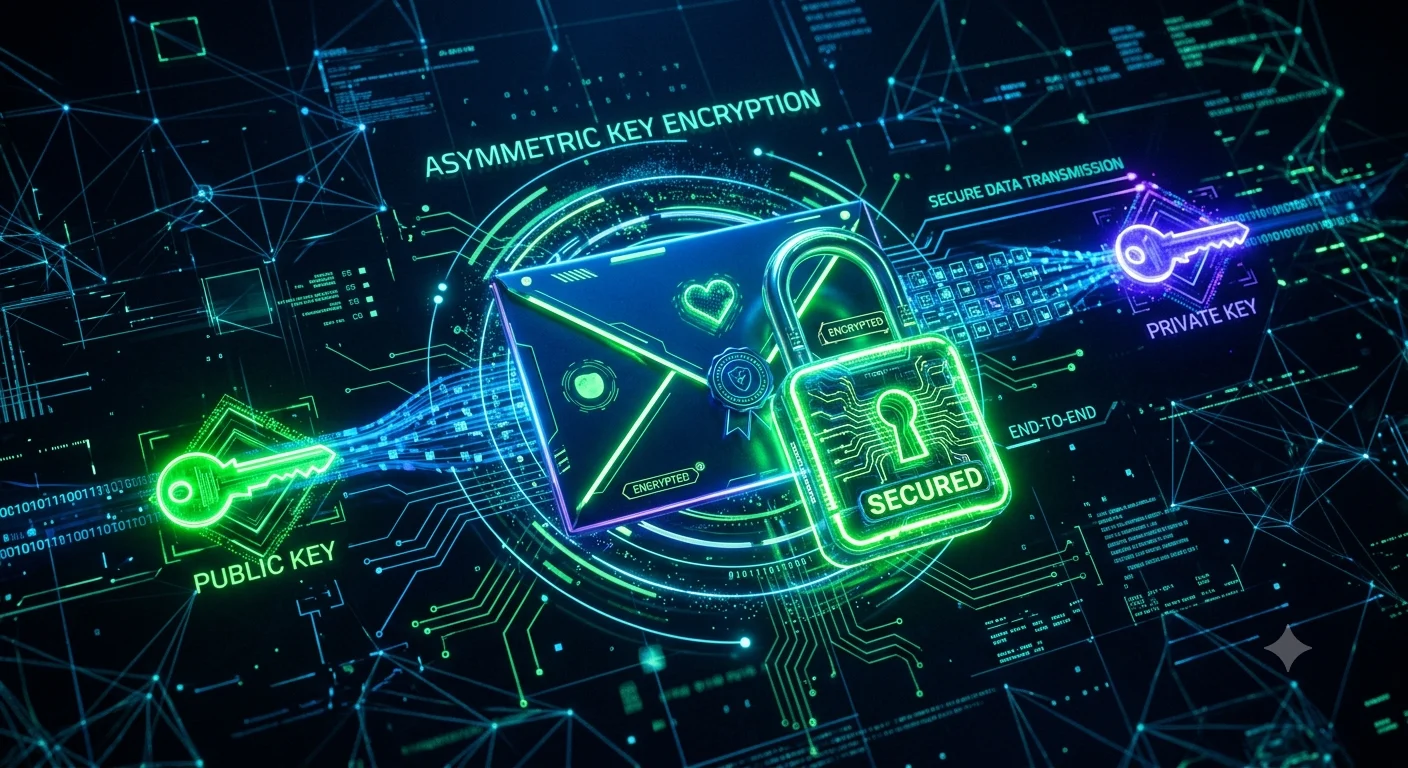
This process relies heavily on a mathematical framework called Asymmetric Cryptography, which uses a pair of keys:
The Public Key: This key is meant to be shared with anyone. Think of it like a public mailbox slot where people can drop letters. Anyone can use your public key to encrypt a message for you, but they cannot use it to read your messages.
The Private Key: This key is strictly confidential and stays safely on your device. It is the physical key that opens the mailbox. Only your private key can decrypt messages that were locked with your corresponding public key.
Step-by-Step: The Encryption Process
To understand how this functions in the real world, let's look at a simple scenario:
Preparation: Alice wants to send a confidential email to Bob. To do this, Alice obtains Bob's Public Key.
Encryption: Alice writes her email. When she hits send, her email software automatically uses Bob's public key to scramble the text into ciphertext.
Transit: The encrypted email travels through the internet. If a cybercriminal intercepts it at this stage, they will only see meaningless code.
Decryption: The email arrives in Bob's inbox. Bob's email client automatically uses his private key to unlock the ciphertext, turning it back into readable text.
The Two Main Email Encryption Protocols
When configuring or selecting a secure email setup, you will generally encounter two primary protocols:
1. PGP / GPG (Pretty Good Privacy)
Developed in 1991, PGP is one of the most widely used encryption standards in the world. It is a peer-to-peer open standard that gives users complete control over their public and private key pairs. It is highly flexible and perfect for decentralized, direct communication.
2. S/MIME (Secure/Multipurpose Internet Mail Extensions)
S/MIME is the standard most commonly adopted by large corporate enterprises. Unlike PGP, where users manage their own keys, S/MIME requires a centralized digital certificate issued by a trusted Certificate Authority (CA). It is built natively into enterprise email clients like Microsoft Outlook and Apple Mail.
Key Benefits of Using Encrypted Email
Total Privacy: It ensures that your private conversations remain strictly between you and your intended recipient.
Data Integrity: If anyone attempts to modify or tamper with an encrypted email during transit, the decryption process will fail completely, alerting the recipient to the breach.
Sender Authentication: Digital signatures included in encrypted emails verify the sender's true identity, completely neutralizing phishing and email spoofing attempts.
Legal Compliance: For businesses, encrypting sensitive data ensures compliance with strict global data protection laws such as GDPR, HIPAA, and CCPA.