
How End-to-End Encrypted Email Works: The Ultimate Guide to Secure Communication
Discover the exact mechanics behind end-to-end encrypted email (E2EE). Learn how public and private keys protect your digital messages from interception and secure your data online. Complete with a 10-step FAQ guide.
How End-to-End Encrypted Email Works: The Ultimate Guide to Secure Communication
Every single day, billions of traditional emails are sent across the globe. We use them to discuss proprietary business ideas, share medical data, exchange financial documents, and manage our digital identities. Yet, standard email protocols are inherently vulnerable.
When you send a normal email, it relies on technology that treats your data like an open postcard. Anyone with access to the routing servers, internet service providers (ISPs), or network nodes along the way can intercept and read your message.
The ultimate solution to this digital vulnerability is End-to-End Encryption (E2EE). But how exactly does end-to-end encrypted email work? Let’s pull back the curtain on the cryptography keeping your private data safe.
What is End-to-End Encryption (E2EE)?
In standard email setups, data is often encrypted only while moving from your device to the email provider’s server. Once it hits the server, the provider decrypts it, reads it (often to serve ads or filter spam), and stores it.
End-to-End Encryption (E2EE) changes this completely. With E2EE, your email is encrypted directly on your device and remains completely unreadable as it passes through every single server, router, and third-party network. It can only be decrypted by the final recipient on their local device. Even the email hosting company itself cannot read the content of your message.
The Core Mechanics: Asymmetric Cryptography
The driving force behind end-to-end encrypted email is a mathematical framework known as Asymmetric Cryptography (also called Public-Key Cryptography). Unlike traditional symmetric encryption, which uses the same password to lock and unlock a file, asymmetric systems use a mathematically linked pair of two distinct keys:
1. The Public Key
The public key is made available to the entire world. You can think of it like your physical business address or a public mail slot. Anyone can use your public key to encrypt (lock) a message intended for you, but it cannot be used to read or decrypt anything.
2. The Private Key
The private key is strictly confidential and never leaves your device. This is the physical key that opens your locked mailbox. Only your unique private key can reverse the mathematical process and decrypt a message that was locked using your public key.
Step-by-Step: The E2EE Journey
To understand how these keys interact seamlessly in the background, let's track an email sent from Alice to Bob:
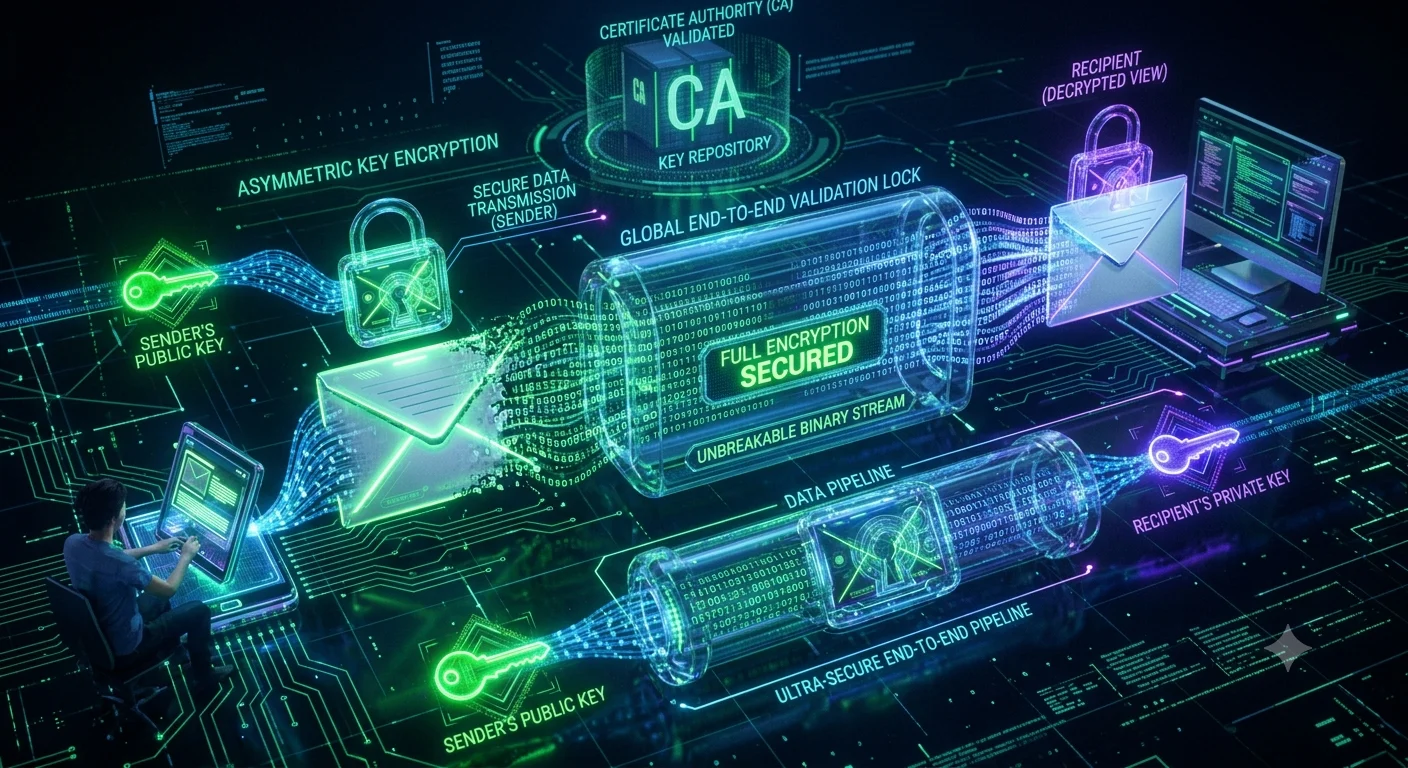
[ Alice's Device ] ---> ( Encrypted with Bob's Public Key ) ---> [ Secure Transit ]
                                                                        |
[ Bob's Device ]   <--- ( Decrypted with Bob's Private Key ) <----------+
Step 1: Key Exchange: Alice wants to send an encrypted email to Bob. Her email client automatically fetches Bob’s Public Key from a secure directory.
Step 2: Local Encryption: Alice writes her message. When she clicks "Send", her device uses Bob’s public key to scramble the plaintext email into an unreadable string of random characters called ciphertext.
Step 3: Secure Transit: The encrypted ciphertext travels across the internet. If a malicious hacker or an intrusive agency intercepts the email at this stage, they will only see completely useless code.
Step 4: Local Decryption: The email arrives in Bob’s inbox. Bob's email application uses his local, hidden Private Key to unlock the ciphertext and restore the message to readable text.
The Leading E2EE Email Standards
When implementing end-to-end encryption, the digital world relies on two primary open standards:
PGP (Pretty Good Privacy)
Invented in 1991, PGP is a decentralized, peer-to-peer open standard. It gives individuals total control over generating and managing their key pairs. It is highly favored by journalists, activists, and developers who do not want to rely on centralized corporate authorities.
S/MIME (Secure/Multipurpose Internet Mail Extensions)
S/MIME is the standard designed for corporate environments. It requires a digital certificate issued by a trusted third-party Certificate Authority (CA) to verify the user's identity. It is built natively into corporate clients like Microsoft Outlook and Apple Mail.