Sysco Data Breach 2026: Incident Summary
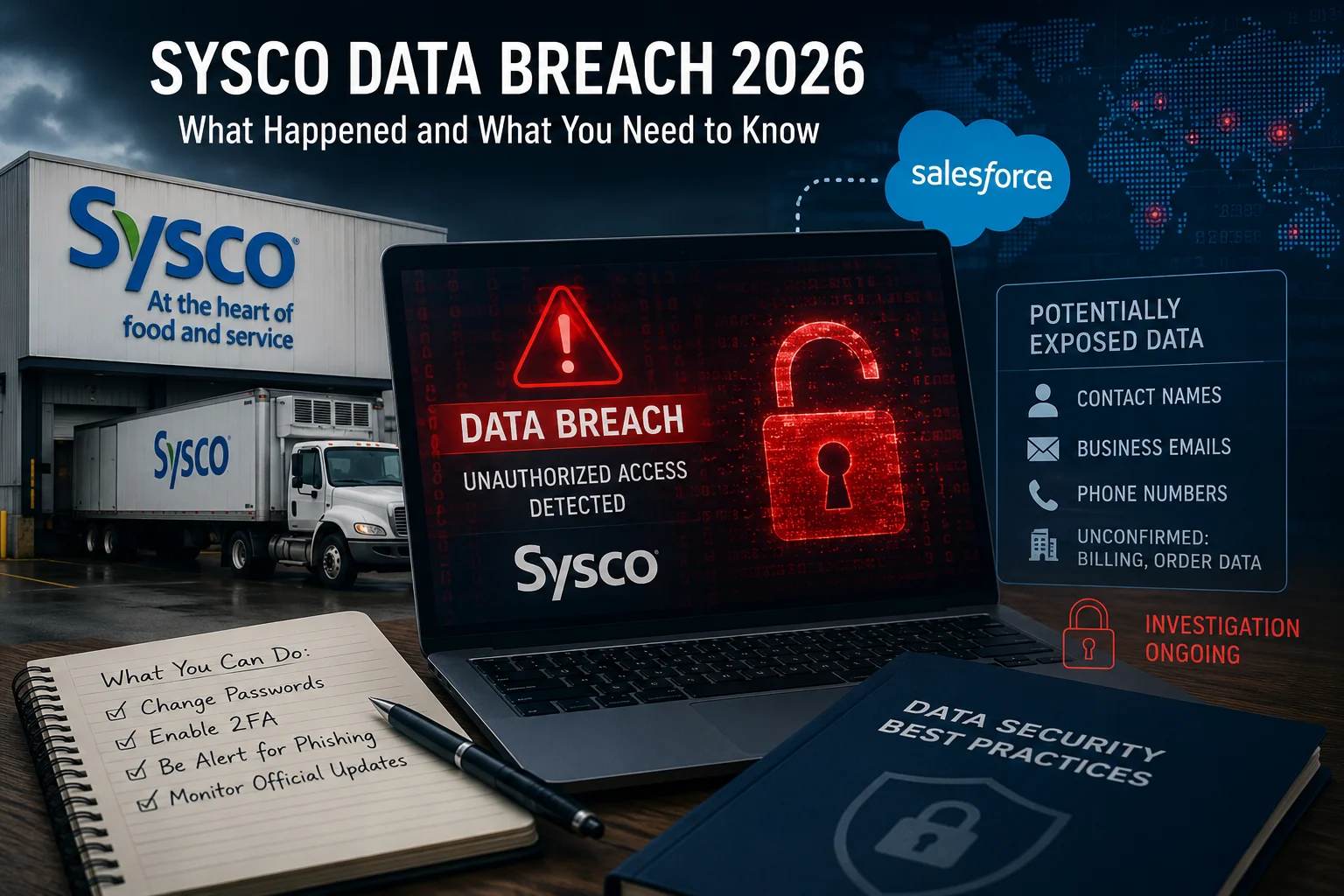
The Sysco data breach 2026 is a reported cybersecurity incident that may have exposed customer information through Sysco's Salesforce CRM environment. While the full scope remains under investigation, businesses that work with Sysco should take precautionary measures such as enabling two-factor authentication, changing passwords, and monitoring official updates.
In brief: The Sysco data breach 2026 is a reported cybersecurity incident that may have involved unauthorized access to customer data through Sysco's Salesforce CRM environment. The full scope has not been officially confirmed. If you are a Sysco customer, taking immediate precautionary steps is strongly recommended.
Quick Summary
- Incident: Reported unauthorized access to customer data
- Reported Date: July 2026
- Affected Platform: Salesforce CRM (Sysco's environment — not Salesforce infrastructure)
- Data Potentially at Risk: Contact names, business emails, phone numbers (unconfirmed: billing, order data)
- Investigation Status: Ongoing — no official final report as of July 2026
- Recommendation: Change passwords, enable 2FA, monitor official Sysco communications
"Did Sysco Get Hacked?" — What We Know So Far
Reports of a cybersecurity incident at Sysco began circulating in July 2026. Sysco — one of the world's largest food distribution companies, serving over 700,000 professional customers globally — appeared to be dealing with a serious data security event. As someone who follows cybersecurity developments in the food service industry, this caught my attention immediately. A company of this scale managing such a large volume of B2B customer data represents a significant target.
What follows is a careful summary of what has been publicly reported, what remains unconfirmed, and what steps any business with a Sysco relationship should consider taking. The Sysco data breach 2026 is a developing story — this article will be updated as verified information becomes available. Where details are unconfirmed, this article clearly says so.
Sysco and Salesforce — What Is the Reported Connection?
Sysco Corporation is the largest food distributor in North America, with operations across dozens of countries. To manage its vast customer base, Sysco uses Salesforce — one of the most widely adopted CRM platforms in the enterprise sector. Early reporting on the 2026 incident suggests the breach may have involved Sysco's Salesforce environment, though the precise technical cause has not been officially disclosed as of the time of writing.
It is important to note that Salesforce as a company has not reported any breach of its own infrastructure. According to Salesforce's public trust documentation at trust.salesforce.com, the platform maintains SOC 2 Type II, ISO 27001, and GDPR compliance certifications. If the breach did involve Salesforce, current reporting points to a configuration or access management issue on Sysco's side — not a flaw in the Salesforce platform itself.
This distinction matters: according to the Verizon Data Breach Investigations Report (DBIR) 2025, a significant proportion of SaaS-related breaches involve misconfiguration or credential compromise rather than platform-level vulnerabilities. Whether this applies to the Sysco incident has not been confirmed.
The 5 Key Facts About the Sysco Data Breach
1. The Scale of Sysco Amplifies the Potential Impact
Sysco serves more than 700,000 customers worldwide — primarily businesses such as restaurants, hotels, hospitals, and catering companies. Even a partial breach of its CRM system could affect a very large number of professional contacts. The Sysco data breach is not a consumer-facing incident in the traditional sense; it primarily involves B2B relationships, which means the exposed data may include commercially sensitive business information rather than individual consumer records.
2. What Data May Have Been Exposed — and What Has Not Been Confirmed
Based on publicly available reporting, data that may have been accessible includes professional contact names, business email addresses, and phone numbers stored in Sysco's CRM. It is important to note that the exposure of financial data, billing details, tax identification numbers, or order history has not been officially confirmed by Sysco. Including unverified data categories as confirmed facts would be misleading. The potential exposure of customer contact data alone is sufficient to enable targeted phishing and business email compromise (BEC) attacks.
3. The Role of the Salesforce Environment
Salesforce is among the most security-certified platforms in the enterprise software market. However, platform security and deployment security are two different things. According to the IBM Cost of a Data Breach Report 2025, cloud misconfiguration remains one of the leading initial attack vectors in enterprise breaches. If Sysco's Salesforce environment was involved, the issue may relate to access permissions, API security, or authentication settings — none of which have been officially confirmed as the root cause at the time of writing.
4. The Timeline Remains Unclear
As of July 2026, the exact timeline of the Sysco incident has not been publicly disclosed. In many comparable breaches, there is a gap — sometimes weeks or months — between initial unauthorized access and detection. This period, known as "dwell time," affects the scope of data that may have been accessed. Until Sysco publishes a formal incident report, the timeline should be treated as unknown.
5. Regulatory and Legal Exposure
⚠️ Important note: If the breach involves data belonging to individuals or businesses in the European Union, Sysco may face obligations under the GDPR — including a 72-hour notification requirement to the relevant supervisory authority (Article 33, GDPR). Potential fines under GDPR can reach up to 4% of global annual turnover for serious violations, though actual penalties depend on the specific circumstances and findings of regulators. Businesses that shared customer data with Sysco as part of their orders should also assess their own downstream notification obligations.
Risk Assessment and Recommended Actions
- Email address exposed [Immediate] — Change passwords on all accounts using that email; enable 2FA.
- Phishing risk [Immediate] — Alert your team to suspicious emails referencing Sysco or orders.
- Business email compromise [High] — Verify any unusual payment or invoice requests via phone before acting.
- GDPR obligations (EU businesses) [High] — Notify your DPO; assess downstream notification requirements.
- Ongoing monitoring [Ongoing] — Check HaveIBeenPwned.com; monitor official Sysco communications.
What a Sysco Customer Should Do — Step by Step
Step 1: Verify Whether Your Business Has a Sysco Relationship
If you work in food service, hospitality, or institutional catering, there is a reasonable chance your business has a direct or indirect relationship with Sysco. In larger organizations with multiple suppliers, it is not always immediately clear which vendor holds which data. The first step is to confirm whether your company's contact details, email addresses, or order data were ever shared with Sysco — directly or through a third-party ordering platform.
Step 2: Identify What Data You Shared
Review any contracts, account registration forms, or onboarding documents completed when setting up a Sysco account. At minimum, most business accounts would have shared a contact name, business email, and phone number. Whether additional data such as billing details or order history was stored in Sysco's CRM — and whether that data was affected — has not been confirmed. Do not assume the worst, but do not assume the best either.
Step 3: Contact Sysco for an Official Update
If you are a Sysco customer, it would be reasonable to contact your account representative in writing and request confirmation of whether your account data was affected. Keep a record of the response. Sysco's official communications page and investor relations disclosures are also worth monitoring for formal breach notifications. At the time of writing, no final official statement has been published.
Step 4: Take Immediate Preventive Security Measures
Regardless of whether your data was confirmed as exposed, the following steps are advisable as a precaution: change passwords on any accounts using the same email address registered with Sysco; enable two-factor authentication on email, banking, and business management systems; and brief your team on the risk of phishing emails that may reference Sysco, invoices, or order confirmations. These are low-cost, high-impact measures that should be standard practice regardless of any specific breach.
Step 5: Notify Your Data Protection Officer
If your business operates under GDPR or similar data protection regulations, inform your DPO about the incident. Depending on what data was shared with Sysco and whether it included information about your own customers, you may have independent notification obligations. This assessment should be made with qualified legal counsel, not based solely on Sysco's communications.
Frequently Asked Questions About the Sysco Data Breach
Does the Sysco breach affect customers outside the United States?
Potentially. Sysco operates in numerous countries, and if data belonging to customers in the EU or other regulated jurisdictions was stored in the affected systems, local data protection laws would apply. Businesses in affected regions should monitor official Sysco communications and consult legal counsel regarding any notification obligations they may independently hold.
How can I find out if my data was exposed?
The most reliable source will be Sysco's official breach notification, which — if required under applicable law — must be sent to affected customers within a legally defined timeframe. In the meantime, you can check whether your business email appears in known breach databases using HaveIBeenPwned.com. Contacting your Sysco account representative in writing is also advisable.
Is Salesforce responsible for the breach?
Based on available reporting, the incident appears to involve Sysco's deployment of Salesforce rather than a vulnerability in Salesforce's own infrastructure. Salesforce has not announced any breach of its systems. Responsibility for the secure configuration and management of a CRM environment rests with the organization that deploys it. That said, the root cause has not been officially confirmed, and this assessment may change as more information becomes available.
What immediate steps should I take as a Sysco customer?
Change passwords on accounts using the same email registered with Sysco, enable two-factor authentication, be alert to phishing emails referencing Sysco or your orders, and monitor official Sysco communications. If your business has GDPR or other regulatory obligations, notify your DPO and assess whether downstream notification requirements apply to your own customers.
What is the estimated financial impact of a breach like this?
According to IBM's Cost of a Data Breach Report 2025, the global average cost of a data breach reached $4.88 million — including detection, containment, notification, and reputational costs. For small and mid-sized businesses, costs may range from $50,000 to $500,000 depending on scope and jurisdiction. These are industry-wide averages and do not reflect Sysco's specific situation, which will depend on the confirmed scope of the breach and applicable regulatory findings.
Key Takeaways
- ✔ The Sysco data breach 2026 is a reported incident — the full scope has not been officially confirmed.
- ✔ The breach may involve Sysco's Salesforce CRM environment, not Salesforce's own infrastructure.
- ✔ Confirmed exposed data categories are limited; claims about billing or order data remain unverified.
- ✔ Sysco customers should take precautionary steps now, without waiting for official notification.
- ✔ EU-based businesses may have independent GDPR notification obligations to assess.
- ✔ Monitor Sysco's official communications at sysco.com for verified updates.
What I Would Recommend — and Why It Matters Beyond Sysco
If I were a Sysco customer today, I would not wait for an official notification before acting. The precautionary steps outlined in this article — password changes, two-factor authentication, team awareness — are low-cost and immediately effective. The cost of taking these steps is negligible compared to the potential cost of a successful phishing attack or business email compromise that exploits exposed contact data.
More broadly, the Sysco data breach 2026 is a reminder that data security is not solely the responsibility of large corporations. Every business that shares data with suppliers and partners carries part of the responsibility for understanding what data is held, where it is stored, and what happens if that third party is compromised. Reviewing your supplier data-sharing practices is a reasonable response to any incident of this kind — regardless of whether your specific data was affected.
Have you taken steps to review your data exposure with major suppliers? Share your experience in the comments below.
Sources
- IBM Security — Cost of a Data Breach Report 2025 — Ponemon Institute — ibm.com/reports/data-breach
- Verizon — Data Breach Investigations Report (DBIR) 2025 — verizon.com/business/resources/reports/dbir
- Salesforce Trust — Security & Compliance Documentation — trust.salesforce.com
- European Union Agency for Cybersecurity (ENISA) — Threat Landscape Report 2025 — enisa.europa.eu
- Regulation (EU) 2016/679 — General Data Protection Regulation (GDPR) — Official Journal of the EU
- National Institute of Standards and Technology (NIST) — Cybersecurity Framework 2.0 — nist.gov/cyberframework
Protect Your Email with ONS Mail
Cybersecurity incidents like the Sysco data breach highlight the importance of securing not only your passwords but also your email account. Since email is often the gateway to business systems, using a privacy-focused email service with strong security features can help reduce the risk of phishing, account takeover, and unauthorized access.
If you're looking for a secure email platform, you can learn more about ONS Mail or access your account through the ONS Mail Webmail Login.